
Service
Correcting subluxations in Vilanova
Vertebral subluxation is the chiropractic term for a vertebra that has lost part of its normal mobility or alignment. Dimitri de Borodaewsky locates it during the assessment and uses specific spinal adjustments to bring movement back.
Do any of these sound familiar?
- Your spine feels stiff when you get up or after hours of sitting still
- You turn your neck or back less freely than before
- You spend many hours a day in the same position
- You have had falls, knocks or an accident that you never had checked
- You would like a spinal check-up even without any discomfort
Our approach
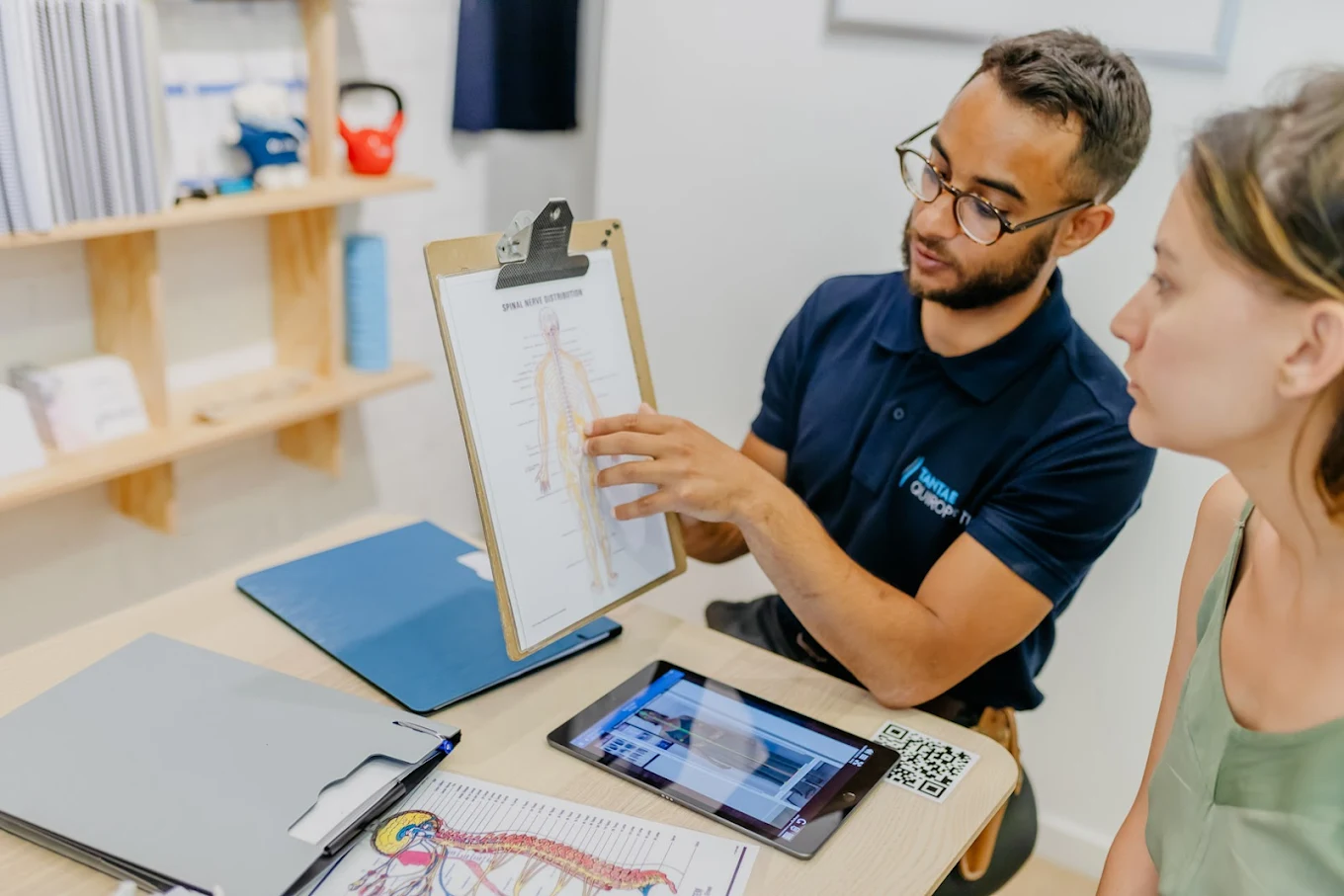
In chiropractic, a subluxation is a vertebra that has lost part of its normal mobility or alignment. Sometimes it causes no discomfort at all and only shows up in the assessment. Dimitri starts with a full functional assessment (postural analysis, mobility tests and palpation of the spine) to find the areas that move least and in which direction. He then applies the specific adjustment to bring movement back to them. Every case is different: at your first visit he explains what he has found and whether chiropractic care is right for you. Chiropractic care does not replace medical care; if you take medication, keep following your doctor's advice.
What we look at in practice
What is a subluxation?
In chiropractic terms, a vertebral subluxation is a vertebra that has lost part of its normal mobility or alignment. It is often linked to sustained postures, repetitive movements, falls or knocks, and periods of high tension.
Correcting subluxations
The chiropractic adjustment is a brief, specific manual movement aimed at the vertebra that moves least, to bring movement back to it. Dimitri adapts the technique to each age and each person. Many people describe it as a sense of letting go of tension; it is also normal to feel slightly stiff for the first few days.
How we work
At your first visit Dimitri assesses your spine, posture and mobility, explains what he has found and, if chiropractic care is right for you, suggests a care plan.
The first sessions focus on bringing movement back to stiff areas. Visits are closer together at the start and are then spaced out.
We review with you how your spine is responding and adjust the plan. Every case is different, so we do not set a fixed number of sessions.
If you wish, regular check-ups to look after the mobility of your spine, much like visiting the dentist. You decide how far you want to go.
Why choose Tantae in Vilanova
- › Dimitri de Borodaewsky, Doctor of Chiropractic, AEQ Member #1373
- › Member of the Spanish Chiropractic Association (AEQ #1373), guaranteeing European university training
- › 259 Google reviews · 5/5 rating
- › A full assessment before any adjustment: if chiropractic care is not right for you, we will tell you
- › Online booking: pick a day and time on the calendar
Chiropractic care does not replace medical care. If you take medication, keep following your doctor's advice.
In Vilanova i la Geltrú and the Garraf, many people spend the day sitting at a desk, drive every day or lift at work, and all of that leaves its mark on the spine. At Tantae we start with a full assessment so you know how your spine is doing and what your options are. Dimitri de Borodaewsky, Doctor of Chiropractic, is AEQ member no. 1373.
Frequently asked questions
¿Cómo sé si tengo una subluxación vertebral?
¿Qué diferencia hay entre un ajuste y una manipulación?
¿El sonido "crack" del ajuste es normal?
Learn more about our chiropractic centre in Vilanova i la Geltrú or discover what chiropractic is →
What our patients say
Testimonial from Eugenio
Testimonial from Engracia
Start today.
Book your first visit.
Pick a day and time right on the calendar. No calls required.