
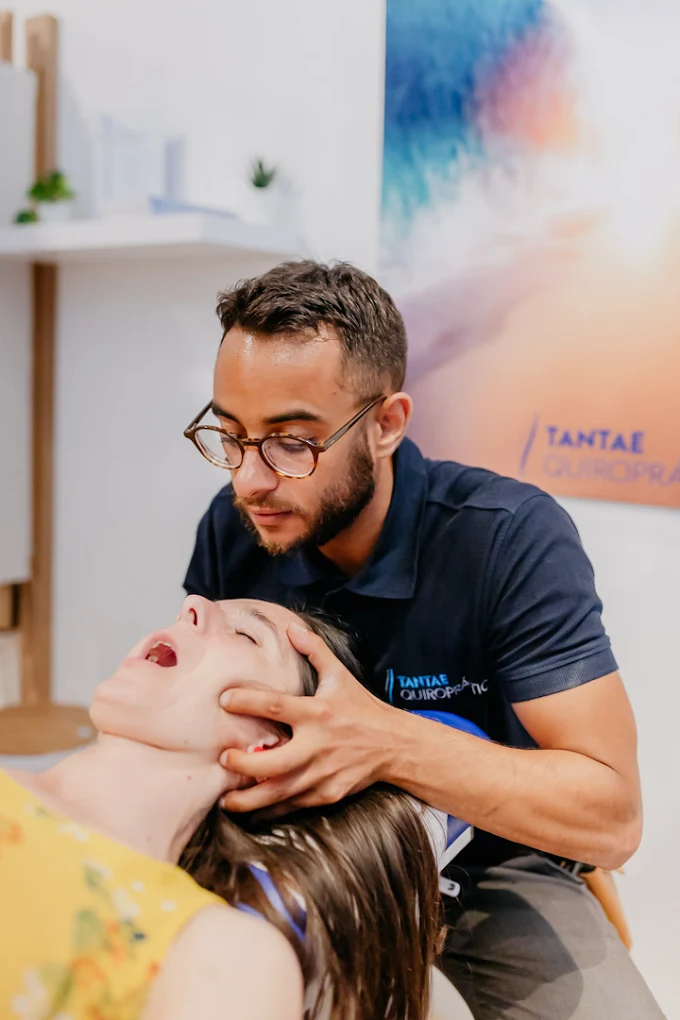
The chiropractic adjustment is the main procedure performed by a university-trained chiropractor to address vertebral subluxations — small losses of mobility or position in a spinal joint which, according to the chiropractic model, may interfere with the normal function of that area. It is a manual movement of high velocity and low amplitude, specific to a particular vertebra, rather than a generic manipulation of the spine.
Adjustment vs manipulation: the difference matters
A manipulation applies a general lever over a region of the spine. An adjustment is a precise impulse on a specific joint, directed along a specific vector, executed after a functional assessment that has identified where the dysfunction is. The difference between the two requires years of university training.
At Tantae, Dimitri de Borodaewsky delivers the adjustment by hand, on a chiropractic table designed to accompany the movement, and in some cases with the help of a specific instrument (the Activator) when the situation calls for it — for example, in babies, in older adults or when an even more localised stimulus is needed.
What an adjustment feels like
The adjustment is quick — the useful impulse lasts a fraction of a second — and is usually accompanied by a sense of local ease or “release”. Sometimes a “crack” sound can be heard; that sound corresponds to the release of small gas bubbles inside the joint capsule (a phenomenon called cavitation). It is not bone on bone, and it does not indicate damage. In fact, many adjustments produce no sound at all.
What the adjustment aims to achieve
The goal of the adjustment is not to “put a bone back in place” in a simplified mechanical analogy, but rather to:
- Support joint mobility in the specific vertebra that had lost it.
- Improve how that vertebra moves in relation to the neighbouring segments.
- Support better day-to-day spinal function, which is the focus of the chiropractic approach to the subluxation.
Each adjustment is tailored to the person: working on an adult athlete is not the same as working on a pregnant woman or a newborn. That is why the prior functional assessment is essential — it defines what to adjust, in what direction and with what intensity.
Regulatory framework in Spain
In Spain, chiropractic is legal but not officially regulated as a healthcare profession. The Asociación Española de Quiropráctica (AEQ) brings together exclusively graduates with a university degree recognised by the ECCE (European Council on Chiropractic Education). Dimitri de Borodaewsky is a member of the AEQ with the number 1373 and graduated from the Madrid College of Chiropractic (MCC) in 2015. Chiropractic care does not replace medical care.
If you want to know more about the chiropractic adjustment or whether chiropractic care can help you, at Tantae Quiropràctic (Vilanova i la Geltrú) we also see patients from the Garraf area and the Penedès. You can book your first visit by picking a day and time directly on the online calendar.