
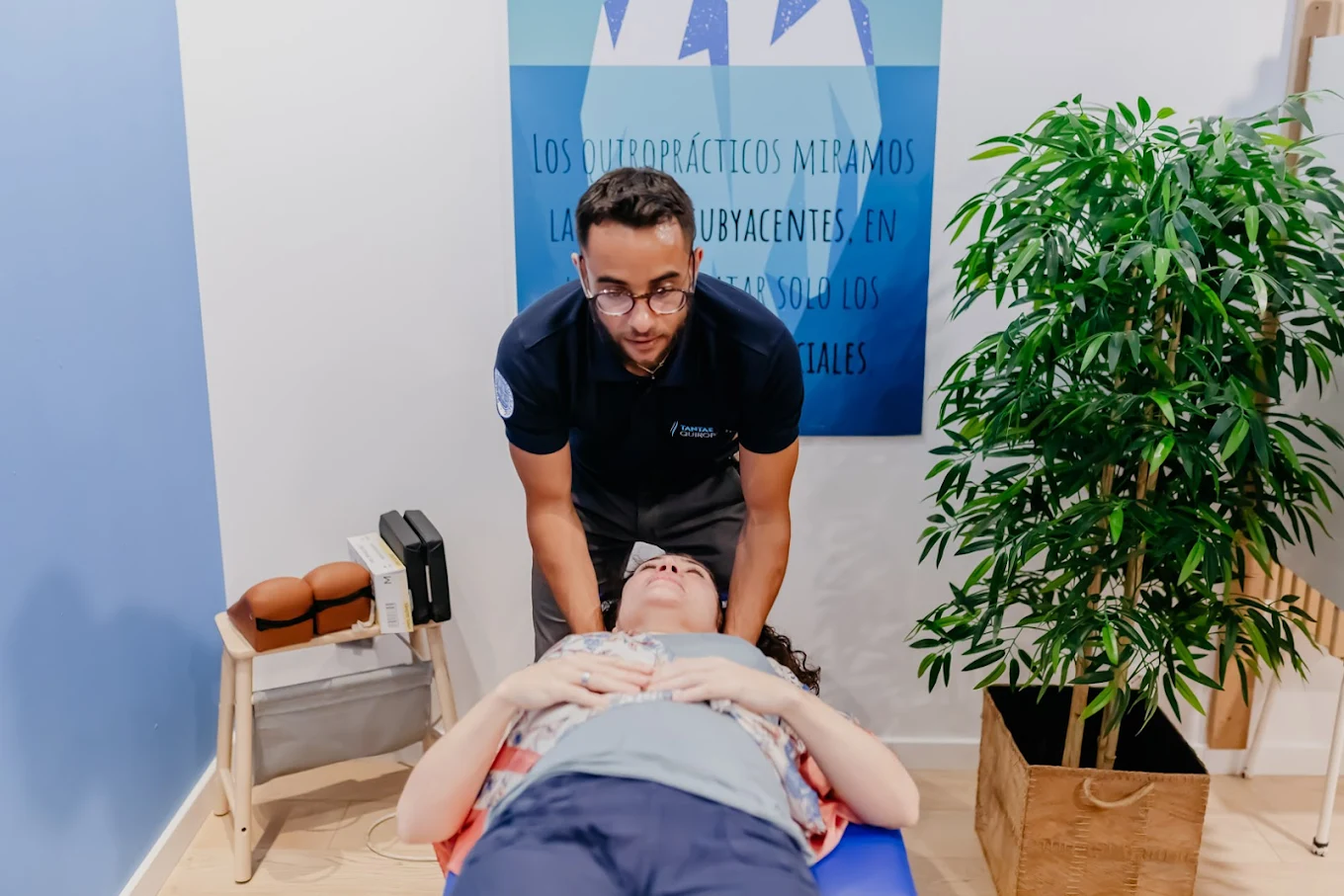
Cervical manipulations and adjustments are one of the most widely used techniques within chiropractic practice. They are applied mainly in patients with mechanical dysfunctions of the cervical joints and, in some cases, with headaches of cervicogenic origin. But what does the scientific literature say about their efficacy?
A systematic review of 21 studies
In 2020, a team of Italian researchers, neurologists and specialists in rehabilitation and sports medicine published a review of the scientific literature with a specific goal: to describe the impact of cervical manipulations on musculoskeletal disorders.
To do so, they analysed 21 articles published between January and March 2020 on manipulations applied to the cervical vertebrae.
What they found
The review concludes that cervical manipulations are effective in patients with musculoskeletal disorders across three measurable dimensions:
- Reduction of pain, both local and referred.
- Increase in joint range of motion.
- Improvement in muscle strength in the region and in adjacent areas.
In addition, the authors observed that cervical manipulation showed efficacy not only in neck pain, but also in conditions at a distance such as lateral epicondylitis (tennis elbow), temporomandibular joint (TMJ) disorders and shoulder pain — a phenomenon known in chiropractic as the regional interdependence effect.
Why it matters
Evidence-based chiropractic moves forward precisely because systematic reviews like this one put numbers to what practitioners observe in clinic. It is not opinion: it is peer-reviewed scientific literature.
In Spain, chiropractic is legal but not officially regulated as a healthcare profession. The Asociación Española de Quiropráctica (AEQ) (founded in 1986, with 430+ members) admits only graduates with a university degree recognised by the European Council on Chiropractic Education (ECCE) — the same body that sets professional standards across much of Europe.
At Tantae
Dimitri de Borodaewsky graduated from the Madrid College of Chiropractic (MCC) in 2015 and is a member of the AEQ with the number 1373. His clinical practice combines functional assessment, the specific vertebral adjustment and, where appropriate, complementary recommendations on ergonomics and movement.
If you want to find out whether chiropractic care can help you, at Tantae Quiropràctic (Vilanova i la Geltrú) you can book your first visit by picking a day and time on the online calendar. We see patients from the Garraf area, Sitges, Calafell, El Vendrell and the Penedès.
Source: review of the scientific literature published in 2020 on the efficacy of cervical manipulations in musculoskeletal disorders.