
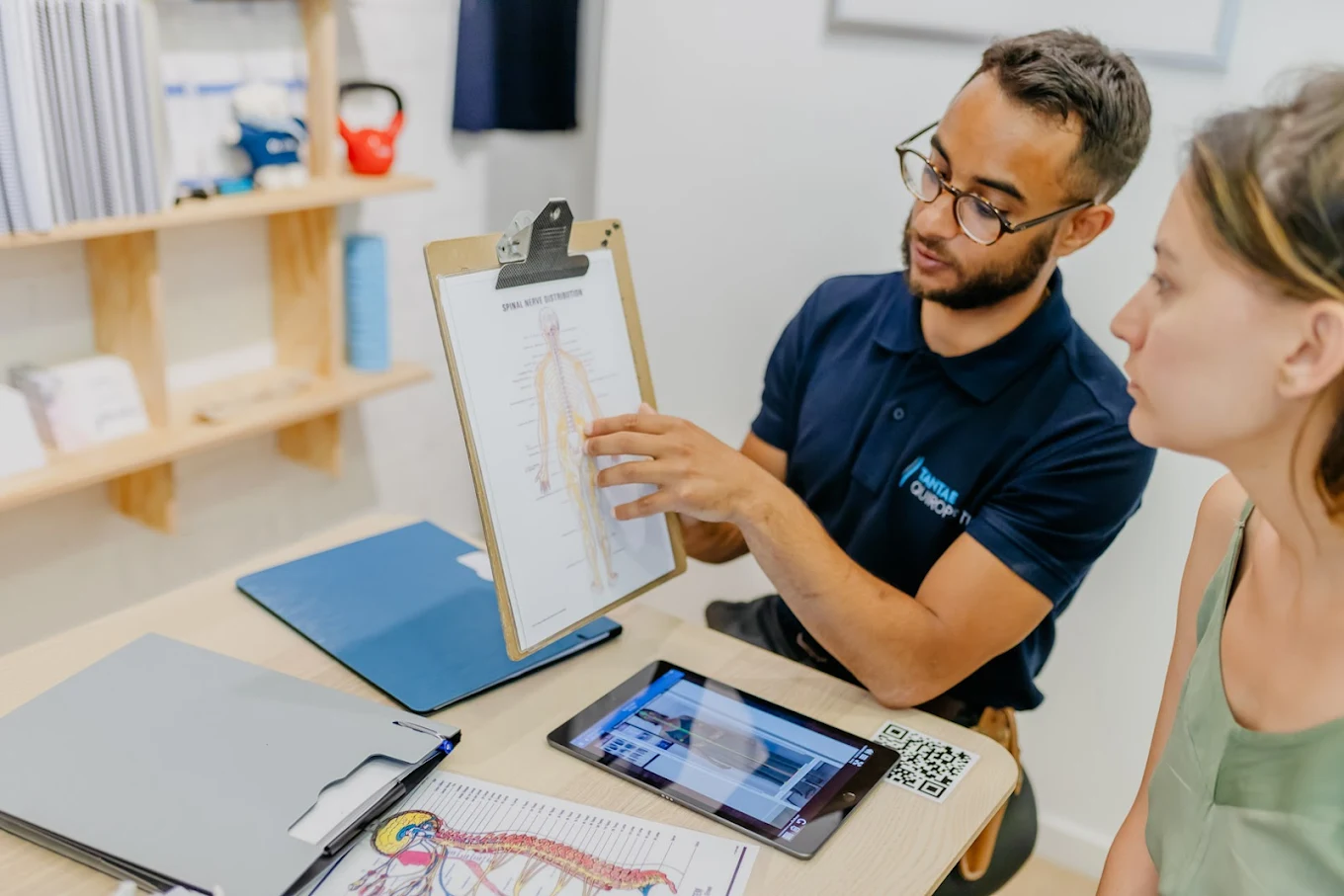
A postural analysis is a visual and functional assessment of the body’s alignment in a standing position: the position of the head, shoulders, hips and weight-bearing points, observed from the front, the side and the back. Its goal is to detect imbalances and compensations the person doesn’t perceive, because the body adapts to them gradually.
Posture is not a matter of aesthetics. It reflects how your spine and nervous system are managing gravity every minute of the day. A postural alteration sustained over time forces muscles and joints to work in positions they were not designed for — and that silent overload is often behind tension that appears “for no reason”.
What does a postural analysis assess?
A complete postural analysis reviews, at a minimum, these six points:
- Head position — whether it sits forward of the shoulders (anterior head carriage, very common with screen use).
- Shoulder height — whether one shoulder is higher or rolled further forward than the other.
- Pelvic alignment — whether the hips are level or one iliac crest sits higher.
- Spinal curves — whether the cervical, thoracic and lumbar curves are increased, flattened or shifted sideways.
- Weight distribution — whether support is symmetrical between both feet or the body loads one side more.
- Knee and foot position — rotations, flat feet or fallen arches that alter the whole ascending chain.
No single finding explains a problem on its own. What matters is the overall pattern: how each one compensates for the others and what they are asking of the spine to keep the body balanced.
Signs your posture may be imbalanced
There are clues you can observe yourself, or that others may have pointed out:
- One shoulder higher than the other in photos.
- Shirt collars or a bag strap that always slides to the same side.
- Asymmetrical wear on the soles of your shoes.
- A forward head position when you look at your profile in a mirror.
- Recurring tension in the same spot (one side of the neck, one trapezius, one side of the lower back).
- Feeling unable to “find a comfortable position” when standing or sitting for long periods.
How is the postural analysis done at Tantae?
At Tantae Quiropràctic the postural analysis is part of the first visit, within the complete functional assessment. Dimitri de Borodaewsky observes static posture from three planes, assesses the mobility of the spine segment by segment and cross-references what he sees with the person’s history: work, sport, rest, previous injuries.
The postural analysis is not an isolated test but the starting point: what it reveals guides the examination of the spine and, where appropriate, the chiropractic care plan. At the report visit we explain what we found in plain language — what your body is compensating for, since when, and what can be done.
Posture and screens: the pattern we see most
The postural pattern we see most often in practice is anterior head carriage with rolled-forward shoulders: hours of phone and computer use tilt the head forward, and every centimetre of forward drift multiplies the load on the cervical spine. The body compensates by increasing tension in the muscles at the back of the neck and upper back.
The good news: posture is not fixed. It is a neuromuscular habit — and habits can be re-educated once the spine regains mobility and the nervous system stops receiving interference from restricted areas.
Regulatory framework in Spain
In Spain, chiropractic is legal but not officially regulated as a healthcare profession. The Spanish Chiropractic Association (AEQ) exclusively brings together graduates with university degrees recognised by the ECCE (European Council on Chiropractic Education). Dimitri de Borodaewsky is an AEQ member, number 1373, and graduated from the Madrid College of Chiropractic (MCC) in 2015.
If you’d like to know how your posture is doing, at Tantae Quiropràctic (Vilanova i la Geltrú) the postural analysis is included in the first visit. We also see patients from the Garraf area, Sitges, Calafell, El Vendrell and the Penedès. You can book your first visit by picking a day and time directly on the online calendar.